What exactly do terms like wide toe box, zero drop, stack height and pronation mean? And what is the difference between a wide shoe and a barefoot shoe?
There is a lot of terminology surrounding footwear and foot health, and the same terms are sometimes used differently by different shoe brands. In this glossary, we explain some of the most common terms in simple, practical language.
At Widetoes, we start with one basic principle: your feet and toes need enough room inside your shoes. That is why we focus on footwear with a wide, foot-shaped toe box.
When it comes to cushioning, sole thickness and flexibility, however, there is no single solution that works for everyone. Some people feel best in very thin barefoot shoes, while others need or simply prefer more cushioning.
Our founder, Lina Björkskog, is a physiotherapist, and our approach is based on an understanding of foot anatomy, available research and – importantly – what actually feels comfortable for the person wearing the shoes.
This glossary therefore covers terminology from barefoot footwear, conventional shoes, running shoes and foot health.
Contents
Shoes and fit: Toe box · Wide toe box · Foot-shaped toe box · Wide shoes · Barefoot shoes · Minimalist shoes · Shoe last · Fit · Foot volume · High instep · Foot length · Foot width · Internal measurements · Growing room and extra space · Shoe width
The sole: Drop · Zero drop · Stack height · Cushioning · Thin sole · Flexible sole · Ground feel · Toe spring · Rocker sole · Heel counter · Arch support
The foot: Forefoot · Midfoot · Foot arch · Hallux · Toe splay · Flat feet · High arches · Hallux valgus · Hallux rigidus · Tailor's bunion · Hammer toe · Plantar fascia · Plantar fasciitis · Heel spur · Metatarsalgia · Morton's neuroma · Achilles tendon
Movement and biomechanics: Pronation · Overpronation · Supination · Gait cycle · Heel strike · Midfoot strike · Forefoot strike · Proprioception · Foot strength · Transitioning to barefoot shoes
Shoes and fit
Toe box
The toe box is the front part of a shoe where your toes sit.
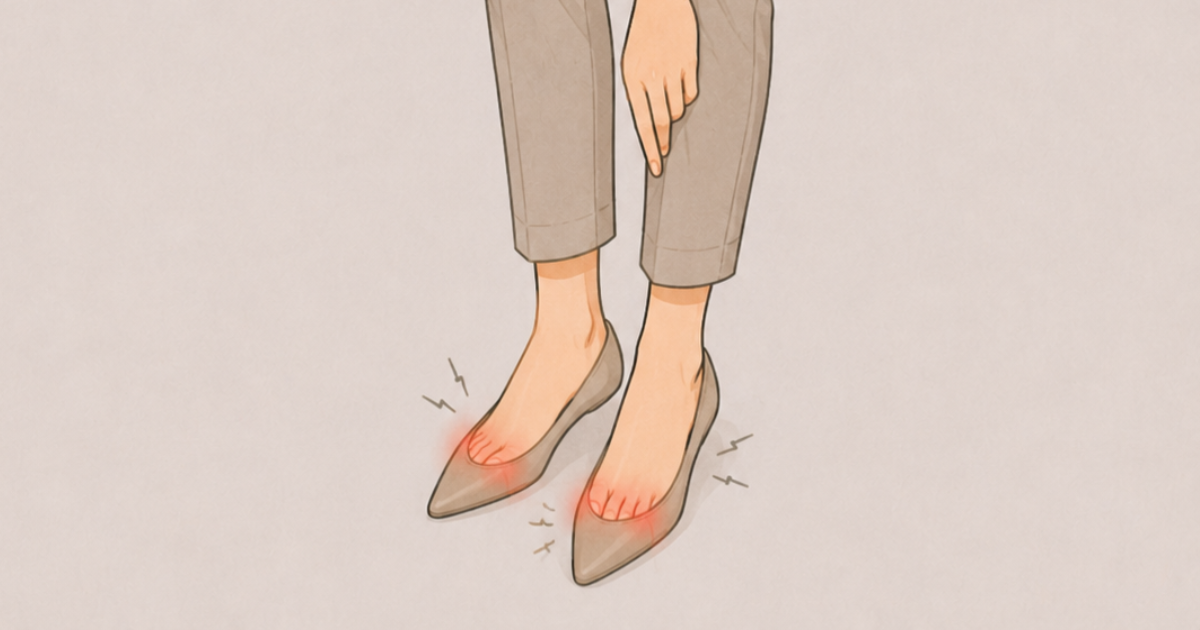
The width and shape of the toe box determine how much room your toes have. Many conventional shoes taper towards the front, even though the foot is often widest across the forefoot and toes.
A roomier toe box gives the toes more space and reduces the amount they are compressed by the shoe.
Wide toe box
A wide toe box means that the shoe provides extra room around the toes.
This does not necessarily mean that the entire shoe is wide. A well-fitting shoe can fit relatively snugly around the heel and midfoot while still providing plenty of space for the toes.
This is an important distinction between a foot-shaped toe box and many conventional "wide-fit" shoes.
Foot-shaped toe box
A foot-shaped toe box is designed to follow the natural shape of the foot more closely than the tapered or pointed shape found in many conventional shoes.
Typically, it does not taper sharply around the big toe or little toe. Instead, the toes have more room to sit naturally alongside one another.
A foot-shaped toe box does not automatically make a shoe a barefoot shoe.
Wide shoes
The term "wide shoes" can mean different things.
A conventional shoe model may, for example, be made on a wider last and sold as "Wide" or "Extra Wide". In these cases, the entire shoe is often made wider.
At Widetoes, our main focus is on shoes that provide enough room for the forefoot and toes, regardless of how the manufacturer labels the width.
Barefoot shoes
Barefoot shoes are designed to allow the foot to move relatively freely while still providing the protection of a shoe.
They typically feature a wide, foot-shaped toe box, a thin and flexible sole, a low stack height and zero drop. The idea is to allow the foot to move and function more like it does when you are barefoot. If you can comfortably walk long distances barefoot without pain, barefoot shoes may feel very natural to you.
That does not mean barefoot shoes are automatically the best option for everyone. Some people love the feeling of a very thin sole, while others prefer more cushioning.
For us, a wide toe box is therefore not synonymous with a barefoot shoe. A wide, foot-shaped toe box can also be combined with a more cushioned sole.
Minimalist shoes
Minimalist shoes are a broader category of footwear with less structure, support and cushioning than conventional shoes.
A minimalist shoe can sit somewhere between a classic barefoot shoe and a conventional shoe.
There is no universally agreed point at which a shoe becomes "minimalist".
Shoe last
A shoe last is the three-dimensional form around which a shoe is designed and constructed.
It influences the shoe's width, shape, toe box, heel shape and overall volume.
This is why two shoes in exactly the same size can fit very differently if they are built on different lasts.
Fit
Fit is about much more than shoe size.
The length, width, shape and volume of your foot, as well as your instep height, all affect how a shoe fits.
This is why the same shoe can fit one person perfectly and another poorly, even if both normally wear the same shoe size.
Foot volume
Foot volume describes how much three-dimensional space your foot occupies.
Two people can have exactly the same foot length and width but still need different shoes because one has a higher or more voluminous foot.
This is why width measurements alone do not always tell you whether a shoe will fit.
High instep
A person with a high instep often needs more room over the top of the foot.
A high instep should not be confused with a high arch. The two can occur together, but they are not the same thing.
Foot length
Foot length is measured from the heel to the tip of the longest toe.
The big toe is not always the longest toe, so measure the full length of the foot rather than simply measuring to the big toe.
It is also a good idea to measure both feet, as it is very common for one foot to be slightly longer than the other.
Foot width
Foot width is usually measured across the widest part of the foot, often around the forefoot.
However, a single width measurement does not tell the whole story. Toe shape, foot volume and the shape of the shoe all affect fit.
Internal measurements
Internal measurements refer to the space available inside the shoe.
This can include both internal length and width.
The inside of the shoe needs to be larger than the foot itself because the foot requires some additional room when walking.
Growing room and extra space
Children need extra space in front of their toes both to allow the foot to move and to accommodate growth.
Adults also need some extra room in front of the toes. The foot lengthens and changes shape when it is loaded.
The appropriate amount of extra space depends on the shoe, the activity and the individual.
Shoe width: D, E, EE, 2E and 4E
Some shoe manufacturers use letters to indicate shoe width.
For example, D, 2E and 4E are commonly used to describe different widths in running shoes.
The problem is that these systems are not completely standardised between brands. A "Wide" shoe from one brand can therefore fit very differently from a "Wide" shoe from another.
The sole
Drop
Drop, also known as heel-to-toe drop, describes the difference in height between the heel and forefoot.
If a shoe has 20 mm of material under the heel and 12 mm under the forefoot, for example, it has an 8 mm drop.
Conventional running shoes often have a noticeable heel-to-toe drop, while barefoot shoes usually have 0 mm drop. High-heeled shoes have a very large heel-to-toe drop.
Zero drop
Zero drop means that the heel and forefoot sit at the same height inside the shoe.
A shoe can be zero drop while still having a thick sole. Zero drop therefore does not automatically mean that a shoe is thin or that it is a barefoot shoe.
Stack height
Stack height describes the amount of material between your foot and the ground.
A shoe with a low stack height has a thinner sole, while a shoe with a high stack height has more material under the foot.
It is important not to confuse stack height with drop. A shoe can have a 30 mm stack height and still be zero drop.
Cushioning
Cushioning refers to materials designed to absorb and distribute load between the foot and the ground.
Different people prefer different levels of cushioning. The surface and activity also play an important role.
A wide, foot-shaped shoe does not therefore need to have a thin sole. For many people, the combination of a wide toe box and moderate cushioning can be an excellent option.
Thin sole
A thin sole means that there is relatively little material between the foot and the ground.
This makes it easier to feel the surface beneath you and is a common feature of barefoot shoes. The thinner and more flexible the sole, the more freely the foot can move and the more the foot muscles are required to work, in a way that more closely resembles walking barefoot.
A thin sole is not, however, a requirement for a shoe to have a good, roomy toe box.
Flexible sole
A flexible sole can bend and twist relatively easily.
This means the shoe restricts the movement of the foot less.
Barefoot shoes are usually very flexible, while conventional shoes can be considerably stiffer.
Ground feel
Ground feel simply describes how clearly you can feel the surface beneath you through the shoe.
A thin, flexible sole generally provides more ground feel. A thicker, more cushioned sole provides less.
Toe spring
Toe spring refers to the upward curve at the front of a shoe, which positions the toes higher than the rest of the forefoot when the shoe is resting on a flat surface.
Many conventional shoes have a noticeable toe spring. This can help the shoe roll forward through the gait cycle, but with constant use it can also hold the toes in an elevated position and give them less opportunity to move naturally.
Barefoot shoes usually have less toe spring because their soles are thinner and more flexible.
Rocker sole
A rocker sole has a curved shape designed to help the shoe roll forwards during each step.
Rocker geometry is commonly used in shoes with thicker and stiffer soles.
In that sense, it is almost the opposite of the concept behind a very thin, flexible barefoot shoe – but different constructions can work well for different people and different purposes.
Heel counter
The heel counter is the part of the shoe that surrounds and stabilises the heel.
It can range from very rigid to extremely soft and flexible.
Barefoot shoes often have a soft heel counter, while conventional shoes typically have more structure around the heel.
Arch support
Arch support refers to a raised area in a shoe or insole that provides support beneath the arch of the foot.
Conventional shoes and orthotic insoles can have pronounced arch support, while barefoot shoes typically have little or none. When the foot is loaded, the arch naturally lowers slightly and then recoils, helping the foot absorb and distribute load. Strong arch support can limit some of this natural movement and reduce how much the foot's own structures need to work.
The amount of support a person needs or prefers varies from one individual to another.
Foot anatomy and common foot conditions
Forefoot
The forefoot is the front part of the foot and includes the metatarsal bones and toes.
This is often where the difference between a conventionally shaped shoe and one with a wide toe box becomes most obvious.
Midfoot
The midfoot is the area between the forefoot and heel.
A person can, for example, have a wide forefoot but a narrow midfoot, which affects which shoes fit well.
Foot arch
The arches of the foot are formed by bones, ligaments and muscles working together to provide stability, mobility and the ability to manage load. The foot has three main arches: the medial and lateral longitudinal arches and the transverse arch across the forefoot.
The most visible is usually the medial longitudinal arch along the inside of the foot.
Arch height naturally varies from person to person.
Hallux
Hallux is the anatomical term for the big toe.
The big toe plays an important role during walking, particularly during the push-off phase of the gait cycle.
Toe splay
Toe splay describes how the toes spread apart from one another.
A wide, foot-shaped toe box gives the toes more room to spread than a shoe that tapers sharply towards the front.
Flat feet
Flat feet means that the longitudinal arch of the foot is low or lowers considerably when the foot is loaded.
This is not automatically a problem. Many people have low arches without experiencing pain or other symptoms.
In some cases, the arch may become more defined and stable as the muscles of the foot become stronger and better able to support the foot's structure.
High arches
A high-arched foot has a higher longitudinal arch. High arches can sometimes be associated with increased stiffness in the muscles and structures of the foot, which can make the foot less adaptable under load.
As with flat feet, having high arches is not necessarily a problem in itself.
Hallux valgus
Hallux valgus is a condition in which the big toe angles towards the other toes while the joint at the base of the big toe changes position.
This can result in a visible prominence or bunion on the inside of the foot.
Shoes with narrow or pointed toe boxes can place pressure on the area and feel uncomfortable. A roomy toe box can therefore be particularly important for people with hallux valgus.
Hallux rigidus
Hallux rigidus is reduced mobility in the joint at the base of the big toe, often as a result of osteoarthritis.
Because the big toe normally bends during push-off, stiffness in the joint can cause discomfort when walking. For some people, a more cushioned and/or stiffer sole can feel more comfortable by reducing load and movement at the big toe joint.
Tailor's bunion / bunionette
A tailor's bunion, also known as a bunionette, is a prominence at the base of the little toe.
It is similar in some respects to hallux valgus, but occurs on the outside of the foot.
A shoe that is too narrow across the forefoot can create uncomfortable pressure over the area. A roomy toe box can therefore be particularly important for people with a tailor's bunion.
Hammer toe
Hammer toe is a deformity in which one or more of the smaller toes are bent at one or more joints.
This can cause the toe to press against the upper or sole of the shoe.
A roomy toe box with sufficient width and height can reduce pressure on the toes and, in some cases, may also give the toes more opportunity to straighten.
Plantar fascia
The plantar fascia is a strong band of connective tissue that runs along the underside of the foot from the heel towards the forefoot.
It helps support the structure of the foot and plays an important role during walking and running.
Plantar fasciitis / plantar heel pain
Plantar fasciitis is a commonly used term for pain around the attachment of the plantar fascia at the heel.
Heel pain can have several causes, and treatment should be adapted to the individual.
There is therefore no single type of shoe that can be considered the right solution for everyone with heel pain.
During the acute stage, additional cushioning under the heel can help reduce load and ease symptoms. In the longer term, progressive strengthening of the foot and calf can improve the tissues' ability to tolerate load. For some people, barefoot shoes may be one way of gradually increasing the amount of work done by the foot itself, but the transition should be gradual and adapted to the individual.
Heel spur
A heel spur is a bony growth on the heel bone that can be seen on an X-ray.
A heel spur and heel pain are not the same thing. It is possible to have a heel spur without pain, and to experience heel pain without having a heel spur.
Metatarsalgia
Metatarsalgia is an umbrella term for pain in the forefoot, usually around the heads of the metatarsal bones.
It describes the location of the pain rather than one specific diagnosis.
Morton's neuroma
Morton's neuroma involves irritation and thickening of tissue around a nerve in the forefoot, most commonly between the third and fourth toes.
Tight shoes can increase pressure across the forefoot and aggravate symptoms. Having enough room in the forefoot can therefore be particularly important.
Achilles tendon
The Achilles tendon is the large tendon connecting the calf muscles to the heel bone.
The load placed on the calf and Achilles tendon is influenced by several factors, including the way we walk and run and the construction of our shoes.
If someone has spent a long time wearing shoes with a significant heel-to-toe drop, the calf–Achilles complex may have adapted to that position. Switching from higher-drop shoes to zero-drop footwear changes the load on these tissues and may therefore require a period of gradual adaptation.
Movement and biomechanics
Pronation
Pronation is a natural movement in which the foot, among other things, rolls slightly inward as it is loaded.
Everyone pronates to some degree. Pronation is therefore not, in itself, a fault that needs to be corrected.
Overpronation
Overpronation is a term used to describe the foot rolling inward more than is considered typical. The term is frequently used in the running and footwear industries, but the relationship between pronation, footwear and injury is more complex than was once believed.
For some people, strengthening the foot and lower leg can improve stability and control. As the muscles become stronger, they may provide better support for the arch and improve control of inward movement. Pronation itself, however, is a natural part of gait and does not necessarily need to be corrected if it is not causing problems.
Supination
Supination is the opposite movement to pronation, with load shifting more towards the outside of the foot.
Strength, mobility and control in the muscles and joints of the foot and lower leg can influence this movement. Like pronation, supination is a natural part of foot movement and is not necessarily a problem in itself.
Gait cycle
The gait cycle describes what happens from the moment one foot makes contact with the ground until the same foot makes contact with the ground again.
During a typical step, the foot lands, accepts the body's weight, the body moves forwards over the foot, and the foot finally pushes off from the ground.
Heel strike
Heel strike means that the heel is the first part of the foot to make contact with the ground.
It is common during walking and is also seen in many runners.
Midfoot strike
A midfoot strike means that the foot lands relatively flat, with the middle of the foot and heel taking load at roughly the same time.
The term is mainly used when discussing running gait and technique.
Forefoot strike
A forefoot strike means that the forefoot makes contact with the ground before the heel.
It occurs in running and is particularly common during faster running and sprinting.
There is no single foot-strike pattern that is automatically best for every runner, although forefoot striking is often seen among runners who place a strong emphasis on running technique.
Proprioception
Proprioception is the body's ability to sense where different parts of the body are and how they are moving without having to look at them.
The nervous system continuously receives information from muscles, joints, skin and other sensory structures.
A thinner sole allows you to feel more of the surface beneath you and may make you more aware of your feet, but proprioception is a much broader biological system than simply the contact between the foot and the ground.
Foot strength
The foot contains many small muscles and also works together with larger muscles in the lower leg.
Just like muscles elsewhere in the body, their strength and capacity can change depending on how they are used and trained.
Footwear is one of many factors that influence how the feet are loaded.
Transitioning to barefoot shoes
If you have spent a long time wearing conventional shoes with substantial cushioning and a higher heel-to-toe drop, barefoot shoes can represent a significant change.
Muscles, tendons and other tissues are exposed to different loads. It therefore makes sense to adapt gradually rather than immediately switching all of your walking and running to very thin, zero-drop shoes.
How quickly someone can make the transition varies from person to person.
Wide toe box or barefoot shoes – which should you choose?
This is perhaps the most important distinction in this entire glossary:
A shoe with a wide toe box does not have to be a barefoot shoe.
A barefoot shoe typically combines a wide, foot-shaped toe box with a thin sole, high flexibility and zero drop.
But it is also possible to make a shoe with a wide, foot-shaped toe box, zero or low drop and considerably more cushioning.
For many people, the toe box is the most important place to start. The toes should have enough room without being compressed. From there, sole thickness, cushioning, flexibility and heel-to-toe drop can be chosen according to what feels good and works for the individual's body and activity.
Some people love the feeling of an extremely thin barefoot shoe. Others want a wide toe box but considerably more cushioning when spending an entire day walking on hard surfaces. Many people use different types of shoes for different situations.
There does not have to be one single type of shoe that is "right".
At Widetoes, you will therefore find both traditional barefoot shoes and more cushioned shoes with wide, foot-shaped toe boxes. What they have in common is simple: your feet – and especially your toes – should have enough room.